The cake stand on the feet of piping is greater than you might imagine.
When practicing cake decorating, many people focus almost entirely on the piping tip, the state of the cream, and the turntable technique but rarely seriously consider one question: Is the “foundation” under your feet stable?
The “foundation” mentioned here is the cake stand.
I used to think that as long as my piping skills were good, it didn’t matter which tray I put the cake on. Until one time, for convenience, I practiced by placing the cake directly on a thin, unstable platform. Before I could even finish piping the border, my hand started to tighten involuntarily—that’s when I truly realized that the cake stand has a much more direct impact on the feel of piping than I had imagined.
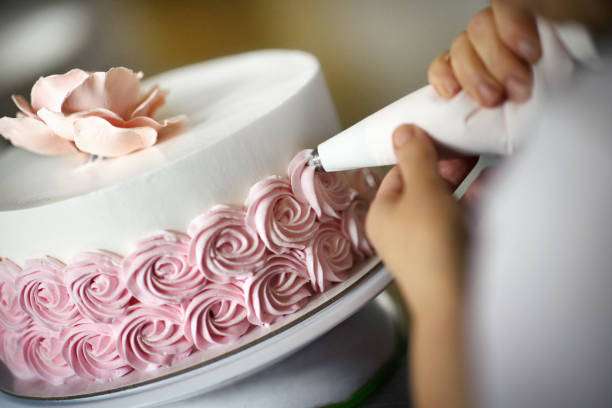
Why is the feel of cake decorating related to the cake stand?
While cake decorating may seem like a task requiring only the “hands,” it is actually a collaborative effort involving the hands, eyes, body, and supporting system.
And it is precisely this often-overlooked link in the system.
1. Piping is essentially a matter of “precision control.”
During the piping process, you need to do the following simultaneously:
- Stable force application
- Uniform extrusion
- Continuous movement
- Angle consistent
Any slight instability will be magnified into jittery lines and uneven patterns.
If the base itself is unstable, or if it gets stuck when rotating, your hand will subconsciously “compensate” for this instability, and over time, the feel of the hand will become distorted.
Different types of cake stands on the feet of piping.
1. Lightweight: Most likely to affect the feel for beginners.
Many entry-level trays are lightweight for portability and cost control.
Common problems with these trays when decorating include:
- It is easy to wobble when rotating.
- With a little force, the whole thing will shift.
- The hand must constantly adjust the angle
The result was that people learned to be “nervous” before they even learned how to pipe.
When I first started practicing piping, I used a platform that was too light, so I had to deliberately slow down every time I piped a circle, which actually made it easier for the piping to break.
2. Stable type: Most noticeable improvement in feel.
When the base has sufficient weight and a non-slip design, the decorating experience changes significantly:
- It is easier to maintain the same force with your hand.
- More even rotation rhythm
- Consistent visual and tactile feedback
You’ll find that piping suddenly becomes a “controllable” process.
Many people think it’s because the technology has suddenly advanced, but it’s actually just that the support system has finally stabilized.
3. Rotatable vs. Fixed
Rotatable tray: More suitable for continuous lace and side piping, wrist-friendly.
Fixed base: Suitable for partial decoration, but can cause fatigue during prolonged use.
If you frequently practice edging, shell patterns, and rose lace, a platform with smooth rotation is almost a necessity.
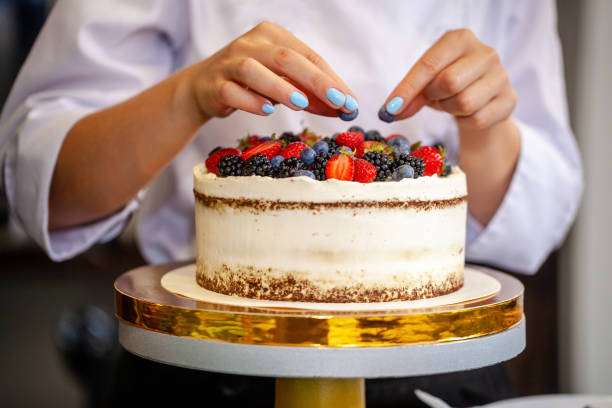
How do the “details” of the cake stand directly affect the stability of the cake decorating?
1. Smooth rotation ≠ Fast rotation
Many people mistakenly believe that the faster the spinning, the better, but in reality:
- Too fast: The lines are easily elongated.
- Uneven: The rhythm of the pattern is disrupted.
A good base should be easy to move and stop decisively.
2. The impact of height on viewing angle and feel
If the shelf is too low, it will cause:
- Unnatural wrist angle
- The line of sight was forced downwards
- Shoulders are prone to tension
A properly sized cake stand allows you to maintain a natural standing or sitting posture while decorating, a source of comfort that many people overlook.
3. Countertop stability and anti-slip design
Anti-slip mats and weighted bases—these seemingly insignificant designs are actually
- The key to a stable rhythm
- Insurance to reduce accidental damage to flowers
Especially in the later stages of decorating, when hands are fatigued, a stable platform can significantly reduce mistakes.
Why does the same technique produce different results when using a different cake stand?
There’s only one reason: feeling is shaped by the environment.
When you practice on an unstable base for a long time, your brain gets used to “constantly correcting” rather than “maintaining consistency.”
Once switched to a stable tray:
- More even application of force
- Cleaner lines
- The flower pattern is easier to replicate.
You will suddenly realize that the problem is not entirely in your own hands.
A cake stand differs for beginners and advanced users.
Beginners need a sense of stability even more.
For beginners, the most important thing is:
- Don’t shake
- Non-slip
- Rotation controllable
Stability is paramount.
The advanced stage places greater emphasis on “feedback.”
When you start to focus on the details of the floral pattern, the feedback from the base becomes very important:
- Push as much as you want, and you’ll get as much as you want.
- Stop wherever you want; just stop there.
This is key to improving the consistency of the piping.
Once, I practiced the same lace pattern for several days in a row, but the lines just didn’t look right. Later, I simply replaced the original thin platform with one that had a more stable base. My hand movements were almost unchanged, but the effect was immediately different.
At that moment, I truly realized: a good cake stand doesn’t make you “use more force,” but rather allows you to “not be distracted.”
FAQ
Q1: Is a heavier cake stand always better?
No, the key is whether the weight is evenly distributed, not just the weight itself.
Q2: Do beginners need to buy a rotating cake stand?
If you mainly practice edging and continuous patterns, a rotating tray will significantly reduce the learning difficulty.
Q3: Will an unstable cake stand affect the cream lines?
Yes, even a slight wobbling will be magnified into a jittery line.
Is there a difference in feel between wooden and metal cake stands? The main difference lies in stability and damping, not in the materials themselves.
Q5: Is there a big difference between home and professional cake stands?
The main differences lie in the smoothness of rotation and long-term stability.
Summarize
If you find yourself gripping the cake and producing uneven lines, don’t rush to doubt your technique.
Switching to a stable, smooth cake stand that suits your working habits is often more effective than practicing ten more times.
Start with a base that truly “works with your hands” and make cake decorating an easier experience.
Related Posts
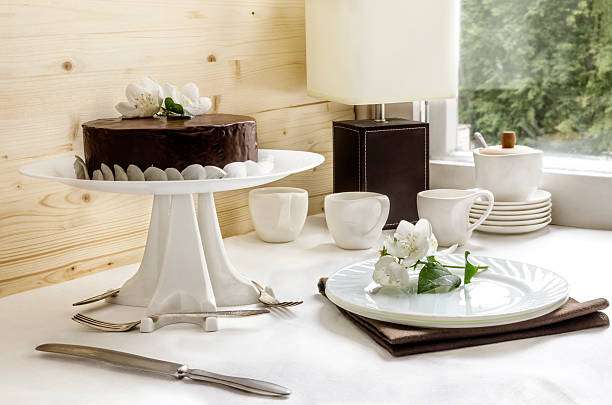
Does the cake stand base matter? How to choose one that is both stable and aesthetically pleasing?
-
Posted by
Cake Stand